2025 regional wage determinations conclude with Northern Mindanao wage orders
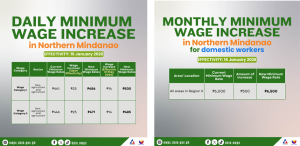
The National Wages and Productivity Commission (NWPC), in its 22 December 2025 meeting, affirmed Wage Order No. RX-24 issued by RTWPB-X for private sector workers in Northern Mindanao which grants an increase of ₱39 in the non-agriculture and agriculture sectors under Wage Categories I and II. This will be given in two (2) tranches.
Wage Category I includes the cities of Cagayan de Oro, Iligan, Malaybalay, Valencia, Gingoog, El Salvador, and Ozamiz and the municipalities of Tagoloan, Villanueva, Jasaan, Opol, Maramag, Quezon, Manolo Fortich, and Lugait.
Wage Category II covers all other areas not mentioned under Wage Category I, and all retail and service establishments employing not more than 10 workers.
These increases will bring the minimum wage rates in the region to a range of ₱485 (Wage Category II) to ₱500 (Wage Category I) upon full implementation.
Meanwhile, Wage Order RBX-DW-06 which grants a ₱500 monthly increase for kasambahays (domestic workers) across Northern Mindanao was also affirmed, bringing the monthly minimum wage for the sector to ₱6,500.
The wage orders of RTWPB-X will be published on 31 December 2025 and will take effect on 16 January 2026.
Minimum Wage Increases
In 2025, 14 wage orders for minimum wage earners in private establishments were issued. These granted daily minimum wage increases for workers in private establishments in NCR, CAR, Regions I, II, III, CALABARZON, MIMAROPA, VI, VII, VIII, IX, X, XII, and XIII ranging from ₱20 to ₱100. All were issued motu proprio, with a majority issued unanimously by the concerned RTWPBs. Meanwhile, RTWPBs XI and V are expected to commence their minimum wage determination processes in January and February 2026, respectively.
The National Capital Region (NCR) remains the region with the highest daily minimum wage rate ranging from ₱658 to ₱695 for workers in private establishments.
A total of 11 wage orders for domestic workers, granting monthly minimum wage increases, have also been issued by RTWPBs in CAR, Regions I, II, III, MIMAROPA, VI, VII, VIII, X, XII, and XIII. These increases ranges from ₱300 to ₱2000 per month.
More than 4.5 million minimum wage earners in the private sector, along with 755 thousand domestic workers, benefitted from the wage orders issued by the RTWPBs in 2025.
In addition, about 8 million full-time wage and salary workers earning above the minimum wage are also expected to indirectly benefit from wage adjustments at the enterprise level in the said region, arising from the correction of wage distortions. Wage distortion occurs when the implementation of a mandated wage increase (i.e. wage order) results in the elimination or severe contraction of intentional quantitative differences in wage or salary rates between and among employee groups in an establishment. NWPC Advisory No. 01, Series of 2023 provides guidance to correct possible wage distortions.
The RTWPBs closely monitor region-specific socioeconomic indicators, in coordination with key government agencies such as the Department of Economy, Planning, and Development (DEPDev), Department of Trade and Industry (DTI), Department of Agriculture (DA), Department of Energy (DOE), Bangko Sentral ng Pilipinas (BSP), and the Philippine Statistics Authority (PSA), to ensure that regional wage policies are informed by current economic conditions, sectoral performance, productivity trends, and regional development priorities. This allows wage-setting decisions to remain responsive, evidence-based, and context-sensitive, aligning them with ILO Convention No. 131 (Minimum Wage Fixing Convention, 1970) and the ILO Minimum Wage Fixing Guide (2016).
Simplified wage structures
A total of five (5) RTWPBs (in Regions II, III, CALABARZON, MIMAROPA, and VII) have been assisted by NWPC to simplify their wage structures and successfully implement streamlining in accordance with the Omnibus Rules on Minimum Wage Determination, as amended, and NWPC Resolution No. 04, Series of 2024 which encourages the RTWPBs to regularly review their wage classifications to ensure consistency with socioeconomic demographics. Said initiative aims to ensure clarity and enhance minimum wage compliance, ultimately supporting a more efficient and transparent wage system for both employers and workers.
Implementation of Minimum Wage Increases and Relief Mechanisms in Calamity-Stricken Areas
The Department of Labor and Employment (DOLE), through the NWPC, also reiterated the guidelines that provide for an exemption mechanism for calamity-affected enterprises following the several typhoons that hit the country and caused significant challenges to businesses in affected areas. Enterprises may inquire and apply through the RTWPB with jurisdiction over their business areas whether they may be eligible for a full exemption or for a specific minimum wage tranche, if any. Businesses and workers are encouraged to visit the NWPC website at https://www.aliflora.vip/ or follow the NWPC Facebook page at https://www.facebook.com/dole.nwpc/ for more details on the exemption process.
Likewise, the Department urged businesses and workers to avail of existing DOLE programs, such as the Adjustment Measures Program (AMP), and take full advantage of the opportunities available to reduce and mitigate vulnerabilities from economic disruptions, including those resulting from natural calamities.
Roll-out of Productivity Initiatives
The RTWPBs that issued Wage Orders have also been instructed to roll out productivity improvement programs and gainsharing schemes designed to foster sustainable and long-term wage growth. These programs particularly target areas within the regions with lower productivity levels, where their implementation can significantly enhance overall efficiency.
As of November 2025, the NWPC and the RTWPBs have provided productivity and orientation to 28,115 MSMEs benefitting 32,211 employers and workers across the country. Of these numbers, 3,525 MSMEs have successfully implemented their action plans, translating knowledge on productivity into actual and measurable improvements in the workplace.
1,754 MSMEs also received technical assistance in designing and formulating Productivity-Based Incentive Schemes (PBIS). PBIS is a workplace-initiated program on improving the productivity of workers and enterprises to generate savings or additional revenues, which can be shared by enterprises with their workers.
As 2025 ends, the NWPC remains committed to supporting the Marcos Administration in maintaining regular and predictable schedule for wage reviews, with a continued focus on fair and transparent wage determination process; simplifying wage structures and promoting productivity improvement programs to foster long-term wage and productivity growth.